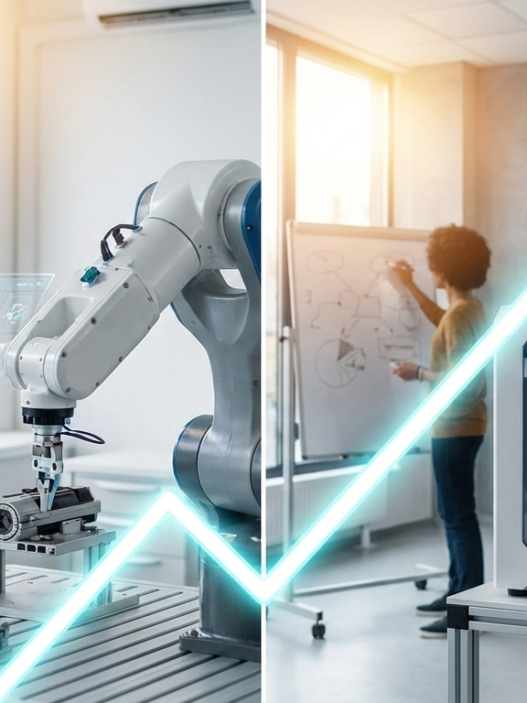
Automation is central to every modern business, shaping and revolutionizing how work gets done. It evolved from simple mechanical processes up to the advanced intelligent system in the world today; therefore, the process has redefined efficiency, productivity, and innovation. This article explores how automation occurred in terms of its history and its most significant milestones as part of getting the intelligent systems that change industries and how the world functions today.
The Evolution of Automation: Development Timeline
The fascinating history of automation stretches across several centuries, and every separate period played a unique role in adding to its magnificent growth and evolution. Let’s take a closer look at this complex journey:
Before 1760: Pre-Industrial Revolution
The history of technology contains some of the first examples of automation in action, such as water wheels and windmills.
Focus: Minimizing human effort in repetitive tasks such as grinding grain.
Industrial Revolution (1760–1840)
Introduction of mechanized systems such as steam engines.
The introduction of the textile mills began replacing long-used labor with assembly lines.
The Age of Electrification (1870–1940)
Electricity made the development of complex machines and early automation systems possible.
Conveyor belts and automated looms increased the efficiency of the factory.
Digital Revolution (1950–1980)
Programmable logic controllers (PLCs) allowed for precision in automation.
Telecommunications and manufacturing, among other industries, have adopted computerized systems.
The Emergence of Intelligent Systems (2000–Present)
Automation got a revolutionary turn with artificial intelligence and machine learning.
Technologies such as robotic process automation and intelligent sensors became the new wave.
Every phase of the automation timeline has played a crucial and significant role in shaping and influencing the importance of automation within today’s advanced intelligent systems.
The Automation Journey: From Manual to Intelligent
This process of automation evolution can be understood in an encapsulated way by dividing it into three major key transitions that this journey comprises:
Manual to Mechanized
During the initial stages of automation, the goal was to replace human manual labor with machines, which increased speed and significantly reduced the possibility of error. The systems developed then were relatively simple and limited in their capabilities, but they formed the basis for further developments in more sophisticated technologies.
Mechanized to Digital
The introduction of computers formed a turning point. Processes turned out to be programmable, and all this could be customized toward accuracy in such industries as banking and manufacturing.
From Digital to Intelligent: The Road Traveled
With the advent of AI and machine learning, systems became capable of learning, adapting, and making decisions. Today’s intelligent automation systems analyze real-time data and offer predictive insights, ensuring businesses stay ahead.
This fantastic journey underscores the gradual evolution and increasing sophistication of automation technology and its significant impact on various industries.
A Brief History of Automation
Knowing the history of automation helps us appreciate its impact:
1764: The spinning jenny was invented. An invention that would mechanize the production of textiles in the future.
1913: Ford’s moving assembly line revolutionized manufacturing efficiency.
The first industrial robot, Unimate, was placed in factories in 1968.
1980s: PLCs and basic robotics became widespread in production lines.
2010s: Intelligent automation emerged with tools like RPA and AI-powered assistants.
Each milestone not only marked the advancement of technology but also reshaped the economic and social structures.
Intelligent Automation Case Studies
The evolution of automation can only be understood by looking at concrete, realistic examples.
Healthcare
Challenge: Managing and processing large volumes of patient records.
Solution: AI-based automation for record-keeping, diagnosis support, and scheduling.
This results in an increase in productivity and a lower administrative burden.
The Retail Industry
Challenge: Personalizing customer experiences.
Solution: Intelligent systems meticulously analyze various aspects of shopping behavior to provide tailored recommendations for products that may interest consumers.
Outcome: Customer satisfaction will increase by 30% along with the sales.
Production
Challenge: Minimize production downtime.
It applies predictive maintenance using IoT and AI.
Outcome: A 40% decrease in unexpected machinery failures.
These examples illustrate transparently how intelligent automation can effectively solve intricate and complex problems that arise across various industries.
The Impact of Automation Evolution
It marked an era of fundamental, unprecedented changes in each industry’s different levels in several areas of their fields:
Economic Impact
- It significantly saves on labor costs as dependence on manpower is reduced considerably for similar repetitive tasks.
- Job Shifts: The workers are significantly shifting to jobs requiring higher skills, especially in automation management and the development of artificial intelligence.
Societal Impact
- Enhanced Services: Implementing automated systems significantly accelerates healthcare and public utilities service delivery.
- Skill Gaps: This emphasizes the importance of ongoing and continuous upskilling to adapt to the significant changes driven by automation effectively.
Environmental Impact
- Sustainability: Automation helps reduce waste and optimize resource usage.
Automation’s broader and more widespread implications have made it an essential and pivotal driver of progress within modern society.
Essential Milestones in Advancing Automation Technology
In the expansive timeline of automation’s development, several remarkable accomplishments distinctly characterize and shape its historical narrative:
The invention of the Steam Engine (1769)
Catalyzed the transformative industrial revolution by massively enabling the large-scale uptake of mechanized production methods.
PLC Introduction (1968)
Enabled accurate and scrupulous regulation over multiple industrial processes and operations.
AI-Driven Automation (2010)
Enabled systems have been designed to acquire knowledge, make predictions, and enhance performance over time.
Autonomous Vehicles (2020s)
Automation reached new heights with the self-driving car and the drone.
Each milestone has added layers of complexity and capability to automation technologies.
Future of Intelligent Automation System
Emerging Trends in Automation
Hyper-Automation
Integrating multiple technologies into a single system will help create seamless, end-to-end workflows.
Edge Computing
Decentralization of automation is underway to accelerate processes and minimize dependency on cloud systems.
Collaborative Robotics (Cobots)
Machines are designed to work in unison with humans for peak performance.
AI-Powered Analytics
Systems that are adequately equipped to give real-time insights enhance user decision-making processes.
This will make for a future where the trends will become so advanced that automation grows adaptive and turns significantly intelligent.
Traditional vs. Intelligent Automation: A Comparison
| Aspect | Traditional Automation | Intelligent Automation |
|---|---|---|
| Capability | Fixed tasks | Adaptive and predictive |
| Technology | Rule-based systems | AI and machine learning |
| Scalability | Limited | Highly scalable |
| Decision Making | Human intervention | Autonomous |
Intelligent automation offers flexibility and efficiency that traditional systems do not.
The Transition From Manual to Automated Systems
This includes several fundamental steps to implement automation
Identify Pain Points
Evaluate processes that take too much time and resources.
Choose the Right Tools
Opt for solutions tailored to your industry, such as UiPath for RPA or Zapier for task automation.
Train Employees
Empower teams by giving them the knowledge and skills to operate and maintain automated systems effectively.
Improve Performance
Use analytics to measure performance and continue making improvements.
A strategic approach would ensure the smoothest adoption and maximum ROI.
FAQs Regarding the Evolution of Automation
What does the term intelligent automation mean?
This integration combines AI with traditional systems, enabling the machine to make decisions and self-learn.
How does automation affect job roles?
While automation reduces the number of manual jobs available, it simultaneously creates new opportunities in technology, artificial intelligence, and data management.
Is automation expensive?
While initial investments in automation are undoubtedly significant, the long-run savings from such systems far outweigh the short-term investment.
Which sectors are most affected by automation?
The highest return on investment, or ROI, for applying automation technologies is seen in healthcare, logistics, and manufacturing industries.
How can small businesses start automating?
Small businesses can start with low-cost tools like Trello, an excellent task management tool, and Slack, a powerful platform for facilitating communication workflows.
Conclusion
The Power of Automation This evolution of automation, from manual processes to intelligent systems, has proved mankind’s ingenuity and the never-ending need for more efficiency. Every significant step in this fantastic journey has fundamentally altered the whole industry, significantly increased productivity, and created opportunities that seemed previously impossible.
As automation advances, businesses must embrace these technologies to stay competitive. The future is not just automated but intelligent, adaptive, and transformative. Organizations can harness automation’s full potential by starting today and shaping a more innovative tomorrow.
Automation is evolving rapidly—from manual processes to intelligent systems—explore our full insights in The Evolution of Automation: From Manual to Intelligent Systems, and discover more on the TechQwaz homepage or learn about our journey on the About Us page. For industry expertise, check out Automation Panda’s automation articles and TestLeaf’s top software testing blogs. Looking for actionable strategies? Don’t miss our suggested read on Supercharge Your Marketing: How AI Writing Tools Can Transform Your Content—your next content breakthrough starts here.